 Unesco Chair in World #Food Systems
Agroecology is a way of redesigning food systems, from the farm to the table, with a goal of achieving ecological, economic, and social sustainability. Through transdisciplinary, participatory, and change-oriented research and action, agroecology links together science, practice, and movements focused on social change. But what are the steps that must be taken to transform food systems toward the ultimate goal of sustainability, and away from the mounting evidence of the negative impacts on the environment and society caused by modern industrial agriculture ?
Home > Keywords > Langue > Anglais
Anglais
Articles
-
 Transforming food systems with agroecology
27 octobre 2021, par Mathilde COUDRAY -
 Food systems at risk
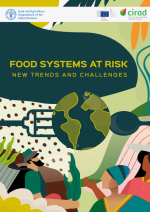
26 octobre 2021, par Mathilde COUDRAYThe way food systems have evolved over past decades means that they now face major risks, which in turn threaten the future of food systems themselves. Food systems have seriously contributed to climate change, environmental destruction, overexploitation of natural resources and pollution of air, water and soils. Despite the global average improvement in calorie production and major development of the food and agricultural product markets, huge inequalities in food access and repartition of the added value have emerged, leading to new serious nutritional and social problems. Based on a review of the most recent scientific knowledge, this report emphasizes Low-Income and Lower Middle-Income countries where the population faces greater challenges than elsewhere. Different threats are adding up and there are few options to adapt or mitigate these combinations of risks. This is a call for all those - businesses, policy makers, consumers, funding agencies - who are engaged in food systems transformations to bear in mind their systemic aspects and their multiple outcomes and risks in order to be able to fashion more sustainable and equitable food systems.
This report was prepared and coordinated by the Centre de coopération internationale en recherche agronomique pour le développement (CIRAD), and is a joint production with the Food and Agriculture Organization of the United Nations (FAO) and the European Commission’s Directorate-General for International Cooperation and Development (DG DEVCO). The scientific report hereunder takes stock of the current and future risks and challenges as regards to food systems.
-
 The rise of supermarkets in Africa, Asia, and Latin America
26 octobre 2021, par Mathilde COUDRAYSupermarkets are traditionally viewed by development economists, policymakers, and practitioners as the rich world’s place to shop. The three regions discussed here have a great majority of the poor on the planet. But supermarkets are no longer just niche players for rich consumers in the capital cities of the countries in these regions. The rapid rise of supermarkets in these regions in the past five to ten years has transformed agrifood markets at different rates and depths across regions and countries. Many of those transformations present great challenges—even exclusion—for small farms, and small processing and distribution firms, but also potentially great opportunities. Development models, policies, and programs need to adapt to this radical change.
-
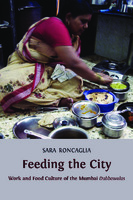 Feeding the city : work and food culture of the Mumbai dabbawalas
26 octobre 2021, par Mathilde COUDRAYEvery day in Mumbai 5,000 dabbawalas (literally translated as "those who carry boxes") distribute a staggering 200,000 home-cooked lunchboxes to the city’s workers and students. Giving employment and status to thousands of largely illiterate villagers from Mumbai’s hinterland, this co-operative has been in operation since the late nineteenth century. It provides one of the most efficient delivery networks in the world : only one lunch in six million goes astray. Feeding the City is an ethnographic study of the fascinating inner workings of Mumbai’s dabbawalas. Cultural anthropologist Sara Roncaglia explains how they cater to the various dietary requirements of a diverse and increasingly global city, where the preparation and consumption of food is pervaded with religious and cultural significance. Developing the idea of "gastrosemantics" – a language with which to discuss the broader implications of cooking and eating – Roncaglia’s study helps us to rethink our relationship to food at a local and global level.
-
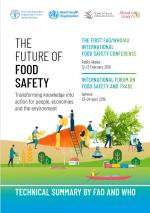 The future of food safety. Transforming knowledge into action for people, economies and the environment
26 octobre 2021, par Mathilde COUDRAYThis technical summary prepared by FAO and the World Health Organization (WHO) reports on the two international food safety conferences held in Addis Ababa and Geneva in February and April 2019. It recalls the key actions and strategies presented to address current and future challenges to food safety globally and the steps required to strengthen commitment at the highest political level to scale up food safety in the 2030 Agenda for Sustainable Development.
At a pivotal moment focussing international attention on actions needed to bolster food safety, this publication recalls the priorities discussed so that food safety strategies and approaches can be aligned across sectors and borders, reinforcing efforts to reach the Sustainable Development Goals and supporting the UN Decade of Action on Nutrition.
-
 Toward a new philosophy of preventive nutrition : from a reductionist to a holistic paradigm to improve nutritional recommendations
27 octobre 2021, par Mathilde COUDRAYThe reductionist approach has been predominant to date in human nutrition research and has unraveled some of the fundamental mechanisms at the basis of food nutrients (e.g., those that involve deficiency diseases). In Western countries, along with progress in medicine and pharmacology, the reductionist approach helped to increase life expectancy. However, despite 40 y of research in nutrition, epidemics of obesity and diabetes are growing each year worldwide, both in developed and developing countries, leading to a decrease in healthy life years. Yet, interactions between nutrition-health relations cannot be modeled on the basis of a linear cause-effect relation between 1 food compound and 1 physiologic effect but rather from multicausal nonlinear relations. In other words, explaining the whole from the specific by a bottom-up reductionist approach has its limits. A top-down approach becomes necessary to investigate complex issues through a holistic view before addressing any specific question to explain the whole. However, it appears that both approaches are necessary and mutually reinforcing. In this review, Eastern and Western research perspectives are first presented, laying out bases for what could be the consequences of applying a reductionist versus holistic approach to research in nutrition vis-à-vis public health, environmental sustainability, breeding, biodiversity, food science and processing, and physiology for improving nutritional recommendations. Therefore, research that replaces reductionism with a more holistic approach will reveal global and efficient solutions to the problems encountered from the field to the plate. Preventive human nutrition can no longer be considered as “pharmacology” or foods as “drugs.”
-
 Malaysian Food Barometer (MFB) : a study of the impact of compressed modernisation on food habits
3 novembre 2021, par Mathilde COUDRAYThe Malaysian society is undergoing rapid modernisation. The
emerging middle class in Malaysia is influencing the lifestyles and traditional food habits of the main three ethnics (i.e. Malays, Chinese, and Indians). This article studied the impact of compressed modernisation on food in a multicultural context. The Malaysian Food Barometer (MFB), published in the year 2014, focuses on the socio-cultural determinants of food habits in Malaysia. -
 A conceptual model of the food and nutrition system
27 octobre 2021, par Mathilde COUDRAYThe integrated model developed here included three subsystems (producer, consumer, nutrition) and nine stages (production, processing, distribution, acquisition, preparation, consumption, digestion, transport, metabolism). The integrated model considers the processes and transformations that occur within the system and relationships between the system and other systems in the biophysical and social environments. The integrated conceptual model of the food and nutrition system presents food and nutrition activities as part of a larger context and identifies linkages among the many disciplines that deal with the food and nutrition system.
-
 Towards a common food policy for the European Union : the policy reform and realignment that is required to build sustainable food systems in Europe
23 novembre 2021, par Mathilde COUDRAYThis report argues for a Common Food Policy for the European Union : a policy setting a direction of travel for the whole food system, bringing together the various sectoral policies that affect food production, processing, distribution, and consumption, and refocusing all actions on the transition to sustainability. The Common Food Policy vision draws on the collective intelligence of more than 400 farmers, food entrepreneurs, civil society activists, scientists and policymakers consulted through a three-year process of research and deliberation.
-
 Land statistics. Global, regional and country trends 1990–2018
26 octobre 2021, par Mathilde COUDRAYThe FAOSTAT Land Use statistics and associated land indicators provide information on the full land use matrix by country, including agricultural land (1961–2018) and forest land (1990–2018). These statistics are based on data collected annually from countries via a standard Land Use, Irrigation and Agricultural Practices questionnaire. Forest land statistics in the dataset are collected separately from countries through the FAO Global Forest Resources Assessment (FRA, 2020). The FAOSTAT Land Cover statistics are conversely produced by FAO, based on its Land Cover Classification System (FAO-LCCS) (De Gregorio, 2015). Information is derived from remote sensing products generated independently by specialized Agencies, currently NASA (MODIS land cover) and the European Copernicus Climate Change service (CCI land cover). Thei brief provides an overview of the main results and changes over time in land use statistics with a focus on agricultural land uses, and with details at global, regional and country level. Additional information is provided on important irrigation and agricultural practices also collected via the above-mentioned FAO questionnaire. It also presents some of the results from the land cover dataset also at global, regional and country level and compares them to land use statistics, thus giving for the first time a joint view of land statistics in FAOSTAT.