 Unesco Chair in World #Food Systems
This paper explores the historical relations between labour organization and product qualification in the production of tropical agricultural exports. In supplying international markets for tropical products, peasant farming emerged as the norm for labour organization after the First World War, competing with the large plantations and different systems of forced labour. During the same period, national standards became the dominant tool for product qualification of commodities traded on the global agricultural markets. These standards allow the creation of futures markets and the emergence of traders, instead of auction markets and commission merchants : two changes that were the basis of the subsequent international marketing of peasant-produced commodities. The last part of the paper considers the potential consequences of the current erosion of standards for the position of peasants in tropical export crop cultivation.
Home > Keywords > Maillon de la chaîne alimentaire > Production
Production
Articles
-
 Small farm production and the standardization of tropical products
26 octobre 2021, par Mathilde COUDRAY -
 Les enjeux de l’agroécologie - Claire Marsden et Stéphane de Tourdonnet
28 octobre 2019, par Mathilde COUDRAYeaucoup des mécanismes qui sont mis en avant en agroécologie passent par le sol. J’ai voulu illustrer à quel point ces processus sont liés à une grande diversité d’organismes et d’interactions dans le sol. Dans certains cas ces processus on les connait suffisamment bien pour pouvoir en extraire un petit élément et le piloter dans les agroécosystèmes, par exemple via des intrants innovants ou des biotechnologies.
-
 La plaine des Quinze Sols
8 avril 2022, par Mathilde COUDRAYAu cours des dernières années, l’intérêt porté aux espaces agricoles périurbains n’a cessé de croître. À travers le prisme de la multifonctionnalité de l’agriculture, nous verrons comment ces espaces sont pris en compte dans l’aménagement urbain et comment ils peuvent répondre à la demande d’espaces de nature en ville tout en conciliant une fonction nourricière. L’exemple de la requalification du site de la plaine des Quinze sols à Blagnac présente quelques outils à disposition des décideurs (…)
-
La Ceinture verte
8 avril 2022, par Mathilde COUDRAYDispositif créé en 2019, La Ceinture Verte a pour objectifs de faciliter et accélérer les installations en maraîchage bio diversifié de porteurs de projets non issus du milieu agricole, ou « hors cadre familial », l’enjeu étant de contribuer à relocaliser l’agriculture nourricière autour des villes.
En proposant aux futurs maraîchers une ferme individuelle ou une ferme sur un site semi-collectif, un réseau d’irrigation, 1 500 m2 de serres automatisées ainsi qu’un bâtiment de stockage, le (…) -
Les fermes urbaines, quelles innovations pour des systèmes alimentaires durables ?
8 avril 2022, par Mathilde COUDRAYEst-il pertinent de cultiver sur des terres urbaines compte tenu des contraintes telles que la pollution et le prix du foncier ? Plusieurs études convergent pour admettre que les besoins alimentaires des villes sont immenses en comparaison de la capacité productive des différentes formes d’agriculture urbaine. Dès lors, quels sont les bénéfices sociaux, économiques et environnementaux auxquels les villes peuvent aspirer dans une logique de durabilité de leur système alimentaire ? Plusieurs (…)
-
 Sur le travail dans la filière cacao - Pierre Ricau
6 février 2023, par Mathilde COUDRAY– Plus d’informations sur Nitidae : www.nitidae.org
– Lire le rapport "Sustainability initiatives in Ivorian and Ghanaian cocoa supply chains : benchmarking and analysis" (Nitidae, EU REDD Facility, 2021)
Lire l’interview dans la revue Sésame -
 Limited food availability
3 novembre 2021, par Mathilde COUDRAYWhile food security is a major worldwide issue, it is a much more serious problem in Low-Income
(LI) and Lower Middle-Income (LMI) countries. Currently, sub-Saharan Africa is the sub-continent with the highest proportion of undernourished people, the largest gap between current and potential yields, and between cereal consumption and production. Looking to the future, population growth and climate change may worsen the situation, particularly in Africa. African countries are still facing rapid population growth with uncertain prospects about the ability of their agriculture to meet growing food demand. In addition, without sufficient adaptation measures, climate change will negatively impact food production in most African regions. -
 The global distribution of acute unintentional pesticide poisoning : estimations based on a systematic review
26 octobre 2021, par Mathilde COUDRAYHuman poisoning by pesticides has long been seen as a severe public health problem. As early as 1990, a task force of the World Health Organization (WHO) estimated that about one million unintentional pesticide poisonings occur annually, leading to approximately 20,000 deaths. Thirty years on there is no up-to-date picture of global pesticide poisoning despite an increase in global pesticide use. Our aim was to systematically review the prevalence of unintentional, acute pesticide poisoning (UAPP), and to estimate the annual global number of UAPP.
We carried out a systematic review of the scientific literature published between 2006 and 2018, supplemented by mortality data from WHO. We extracted data from 157 publications and the WHO cause-of-death database, then performed country-wise synopses, and arrived at annual numbers of national UAPP. World-wide UAPP was estimated based on national figures and population data for regions defined by the Food and Agriculture Organization (FAO). -
 N°13/ Les jardins partagés peuvent-ils promouvoir des modes de vie plus durables ?
3 février 2021, par Mathilde COUDRAYAvec plus de 70 % de la population européenne vivant en ville, il est urgent de promouvoir un développement urbain durable qui garantisse la santé et l’inclusion des communautés, la protection de l’environnement et le développement économique. Les espaces verts urbains sont reconnus comme un élément indispensable dans la conception de villes durables.
-
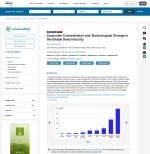 Corporate concentration and technological change in the global seed industry
26 octobre 2021, par Mathilde COUDRAYIn the past three decades, the seed sector has experienced, and is now again experiencing, corporate concentration trends. The fallout of this consolidation is the subject of numerous concerns. However, the seed sector is rather poorly understood. Thus, it is useful to understand it better and to investigate the potential impact on the agri-food chain of the trend toward increased corporate concentration. The first part of this paper presents the main characteristics of the global seed sector, its stakeholders, and its size in the agri-food chain. Next, the corporate consolidation trends of the seed industry over the past two years are examined. The technological evolution of the seed sector is also briefly presented. In the last part of this paper, the fallout of recent mergers and acquisitions in the seed industry are analyzed. Opposing views are expressed on the impact of these mergers and acquisitions in the agri-food chain : while certain stakeholders worry about the risk of food power by the biggest companies, some others expect useful innovations.