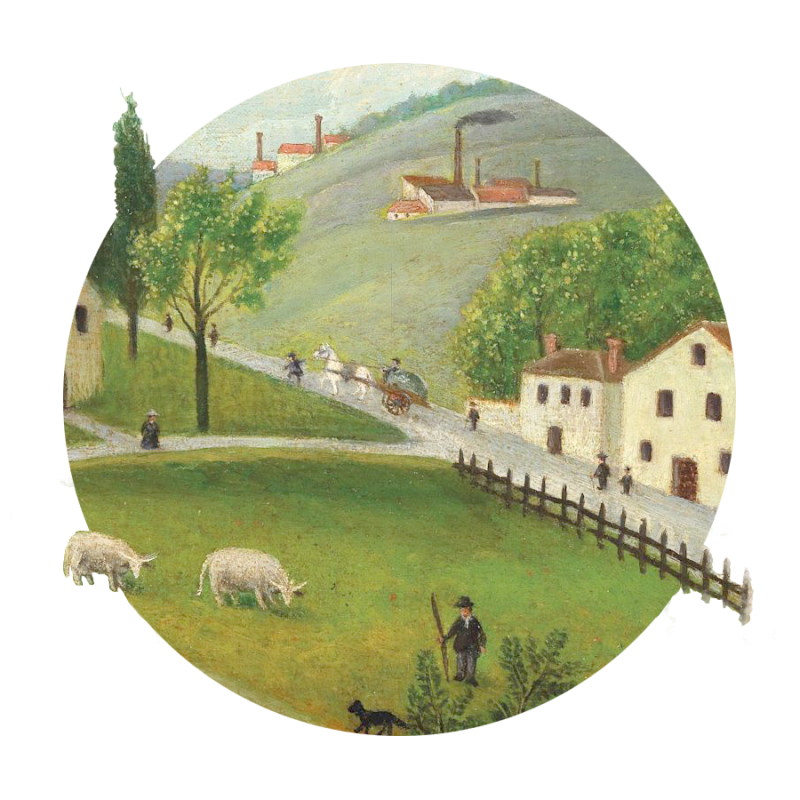
Discover the book marking the Chair’s 10th anniversary: An Ecology of Food.
Illustration by Nathalie Le Gall, 2021
The ecology of food
The ecology of food is :
- The result of building on 10 years of testing a ‘holistic’ vision of food-related issues, recognised as useful by stakeholders with fragmented perspectives.
- An interim statement that is not an end in itself but rather an invitation to conceive of food in a different way and to make it an experimental field for rethinking our relationship with the world.
- An openness to a wide range of research, with the risk that these explorations may remain forever incomplete.
1. Preface - The phagic dimension
Imagine a blade of grass grazed by a ruminant such as a buffalo or gazelle. The gazelle is eaten by its predator – say, a lion. The lion leaves the remains of its meal to vultures, hyenas and other scavengers, and then to detritus feeders such as earthworms. Bacteria and other decomposing microorganisms subsequently intervene and further contribute to the humus enrichment process, but they may themselves be preyed upon by protozoa.
2. Introduction - Food and all its dimensions
This book marks (and celebrates) the tenth anniversary of the UNESCO Chair in World Food Systems, established in 2011 by Professor Jean-Louis Rastoin (Montpellier SupAgro) together with a multidisciplinary group of lecturers and researchers from various institutions¹ on the Agropolis campus in Montpellier. In this sense, this book represents an important milestone: its writing involved a process of reflection on our work, serving as a sort of review of the progress we have made, and provided an opportunity to consider our future commitments.
3. 1. Food as relationships
Food shapes our lives [. . .]. We may not be aware of its influence, but it is everywhere: even in the parts of our brain that can’t stop wondering about the meaning of life. Food’s effects are so ubiquitous that they can be hard to spot, which is why learning to see through the lens of food can be so revelatory. One perceives a remarkable connectivity: an energy that flows through our bodies and world, linking and animating everything as it goes. Carolyn Steel, Sitopia (2020).
Chapitre 1. Food as a link with ourselves
Food, beyond its biological and health functions, connects us with ourselves. It is a source of sensory experience and pleasure, provides the building blocks for our individual and collective identities, and is a vehicle for self-optimization. What we eat today shapes the fate of our bodies and minds and, thus, our futures.
Chapitre 2. Food as a link with other
Food is a vehicle to anchor oneself in the collective and connect with others, whether by sharing food with others at the dinner table, through the social interactions involved in grocery shopping practices, when travelling and embracing food as a gateway to local cultures and related experiences.
Chapitre 3. Food as a link with the biosphere
Humankind is an integral part of nature and even a complex ecosystem in itself. In many ways, food connects us to our immediate surroundings and to the living organisms we encounter and ingest.
4. 2. Dynamics of the contemporary food systems
“What characterises both food consumption and production today is the trend towards the widespread adoption of an industrialised model that is becoming increasingly ‘service-oriented’. Mass consumption and production are the result of the industrialisation of all the sectors that make up the food system.” Jean-Louis Rastoin, The Global Food System (2010)
Chapitre 4. The origins of industrial farming
Agriculture has a long history. Starting at a time when its main source of energy was the sun and it provided food, energy, materials and fertilizers, it reached the current age of industrial agriculture, founded on the widespread use of non-renewable resources and chemicals, and largely reduced to food production.
Chapitre 5. The industrialization of the food supply
A far-reaching transformation of the food supply is underway, fuelled by technical and economic developments that are not specific to the food sector. An industrial food model is emerging and spreading. This model, however, should not be understood as a natural outcome of the way we organize our food supply.
Chapitre 6. Changing food habits
Major contemporary societal changes are reshaping our relationship with food. Nevertheless, it is important to nuance the hypothesis of food-style standardization. Moreover, changes in the way eaters relate to their food can be interpreted as a result of various forms of distancing.
Chapitre 7. The limits of industrialized food systems
Industrialized food systems generate a number of negative environmental, health, socio-economic and political externalities. Identifying these sustainability issues sheds light on the fact that food systems not only play a role in feeding the planet, but they are also instrumental in enhancing the viability of the biosphere while fostering inclusive and resilient socio-economic development.
5. 3. Food and ecology
“Ecology focuses on the connections between living beings and with their environments. It no longer views beings as isolated entities, but as nodes in a complex network of interactions and interdependencies […]. We belong to numerous, intertwined communities. Our commitments and practices are therefore transformed as a result.” Virginie Maris, Corine Pelluchon and Pablo Servigne, Let’s Connect! (2021)
Chapitre 8. Why an ecological approach to food?
Ecology first developed as a scientific discipline and subsequently as a political movement. This points to two arguments for adopting ecology as an analytical framework for thinking about food from a sustainability angle: it constitutes a ‘hub science’ for the study of relationships and has an inherently political dimension.
Chapitre 9. Decompartmentalizing knowledge on food
Food is a multidimensional issue. Together, the perspectives of different scientific disciplines have converged to achieve a shared understanding of this research topic and its associated issues.
Chapitre 10. A commitment to food system transformation
Food is an inherently political issue. We argue that this means inspired commitment is needed in order to keep faith in the possibilities of the food system transition and that this faith is key to overcoming resistance to change.
6. 4. Discussing the watchwords of sustainable food systems
‘The destiny of nations depends on the way they feed themselves.’ Jean Anthelme Brillat-Savarin, The Physiology of Taste (1825)
Chapitre 11. Should food production be doubled to feed the world?
The strategies of the different actors involved in international debates have led to a shift in the concept of food security. In the wake of the 2008 food price crisis, the renewed drive to take a technological quantum leap forward to double food production by 2050 has hindered reflection and discussions on this concept.
Chapitre 12. Fortified foods to fight malnutrition?
Fighting malnutrition requires diet diversification. This is also a good way to support crop diversity. Yet technical solutions, such as food supplements or (bio)fortification, are still considered more innovative, and these dominate policies tackling the challenges of malnutrition.
Chapitre 13. Would you like some more protein?
The question of proteins is one that has developed over time. Today, it features in a range of public debates relating to important nutritional, economic and environmental issues. The excessive focus on proteins makes us run the risk of paying less attention to the need to reduce food consumption, as well as avoiding alarming issues surrounding the status of particular types of foods and animal-related concerns.
Chapitre 14. The fight against food waste
Food waste, though it must be fought, also serves social functions. It is important to put into perspective the responsibility of consumers seen as failing to manage their food waste adequately and to recognize that waste is above all the result of overproduction that has ultimately led to food being devalued.
Chapitre 15. Food aid to fight food insecurity?
While food aid is reserved for emergency situations at international level, in France it has become the main tool to fight food insecurity. Although this aid has an important social function, it has nonetheless been widely criticized for a number of reasons. This has led to experiments with other forms of solidarity based on greater food democracy.
Chapitre 16. Should we return to cooking and ‘homemade’ food?
Home cooking has many cultural and health benefits. Nevertheless, it remains a relatively undervalued daily task that is largely shouldered by women. The commercialization of ‘homemade’ dishes presents interesting opportunities in this regard.
Chapitre 17. Taking a step back from local production
The relocalization of our food restores trust between producers and consumers, often broken by the industrialization and globalization of food supply chains. However, it is entirely possible to recreate locally the same dysfunctions observed at larger scales or to simply promote a narrow-minded localism. This points to the need for a cosmopolitan localism.
Chapitre 18. Active consumers as drivers of change?
Despite some individuals’ conviction that they are playing their part by leveraging their purchasing power, their responsibility in the transition to sustainable food systems is limited. Their consumption behaviour is ultimately constrained by a material, social and political environment, and they cannot be the sole drivers of change.
7. 5. An ecology of food to transform food systems
‘To exist is to “co-exist”. You cannot exist alone, on your own. You can only exist in interdependence with everything that exists.’ Thich Nhat Hanh, The Heart of Understanding (1988)
Chapitre 19. Citizen initiatives and how to scale them
The world of tomorrow is already being experimented with today through a proliferation of citizen initiatives that are inventing new ways of organizing food systems. We explore several ways for these initiatives to expand and enable the necessary transformation of food systems.
Chapitre 20. Towards new company models?
There are two forms of corporate commitment within the food system: the Social and Solidarity Economy (SSE) and Corporate Social Responsibility (CSR). While these two movements have developed independently of each other, at present both are contributing to the transformation of food systems.
Chapitre 21. The roles of training and research
Embracing an ecology of food has implications for the worlds of training and research. Changes are already under way, in terms of both the subjects addressed and the way in which this is done. We share a few avenues for reflection on these changes.
Chapitre 22. Food in politics
The public food policies adopted in Brazil, Canada and France – at both national and local levels – offer valuable insights. There is a proliferation of initiatives encouraging new civil society stakeholders to engage in food systems and thus address emerging issues. The challenges of intersectorality and participation remain to be addressed, and new power dynamics need to be imposed.
8. Conclusion - Food is an encounter with the world... the entire world
As we have seen, food is a powerful force for building relationships and bringing people together within the living world, as well as being a unique vehicle for political engagement: food affects everyone on a daily basis; it touches on a wide range of areas (the environment, health, education, solidarity, enjoyment, identity, etc.); and it is linked to a vast number of economic activities on which it depends.