Urban food systems
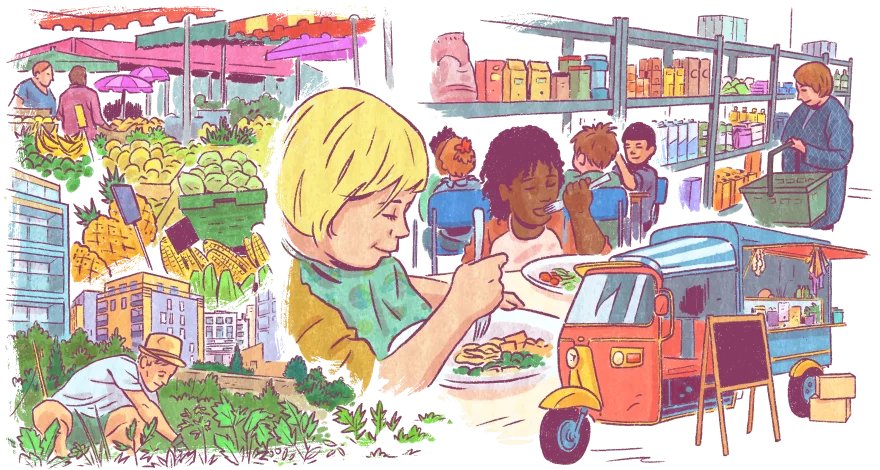
As a result of rapid urbanisation, urban areas have regained significant social, economic and political influence. This enables them to play a major role in the sustainability of food policies. This movement has gained strength in recent decades, leading to the development of food environments that promote access to sustainable food for all.
As a result of rapid urbanisation, urban areas have regained significant social, economic and political influence. This enables them to play a leading role in the sustainability of food policies. This movement, which began in pioneering cities such as Toronto (Canada) and Belo Horizonte (Brazil), has gained strength over the last two decades, with the overall aim of developing food environments that promote access to sustainable food for all.
This requires initiatives addressing issues such as governance, land management, the development of supply infrastructure, improvements to institutional catering, commercial urban planning, waste management, urban agriculture, and so on.
Reconnecting an urban region with its food-producing hinterland and developing equitable trade with more distant territories: thisi s one of the aims of the TerrAsol project, which currently guides the Chair’s investment in the field of urban food systems.
A wide range of resources, including articles and books, are available in French through the French page of the website.
Project
Afrifoodlinks
To transform urban food environments in Africa by strengthening links between stakeholders in food systems in cities across the continent and in Europe.

TerrAsol
TerrAsol (Solidarity-based Agricultural and Food Territory) aims to demonstrate the value of a new approach and a new governance model for food transitions, based on the concepts of solidarity and food democracy, in the Montpellier area.

School meals
Find out here about the activities of the international research consortium on school catering and the French RESCO network in which the Chair is involved.

URBAL
Urban-Driven Innovations for Sustainable Food Systems is an international project that uses participatory research in eight cities to develop and test a holistic methodology for mapping the pathways of impact from urban innovations to all dimensions of food system sustainability.

Resources
3rd edition “Eating in African, Latin American and Asian Cities”
Discover the 3rd edition of the international symposium “Eating in African, Latin American and Asian Cities”
Symposium - Feeding Cities: Rural-Urban Connections and the Future of Family Farming
This two days international conference commemorates the 20th anniversary of the Centre for Studies in Food Security at Ryerson University, and celebrates the International Year of Family Farming. It address questions and issues concerning the future of family farming in an increasingly urbanized world.
Eating in the city: urban food styles in Africa, Latin America and Asia
International symposium organized by the UNESCO Chair in World Food Systems (Montpellier SupAgro and CIRAD), UMR Moisa (CIRAD, INRA, Montpellier SupAgro, CIHEAM-IAM), OCHA (CNIEL) and the Edgar Morin Center of the Interdisciplinary Institute of Contemporary Anthropology (IIAC).
Eating in the city: sustainable distrust?
The third day of the international "Eating in the City" symposium, where the first two days were summed up with presentations on how distrust manifests itself in recently industrialized countries. The discussion focused on the topic, ‘From nutrition to politics, from the symbolic to the ecological’, and proposed an interdisciplinary approach to this consuming distrust.
Comer en la calle (Eating in the Cities)
The second edition of the Symposium on “Eating in African, Latin American and Asian Cities”.
Seminar: Impact assessment of food innovations
A seminar presented by the URBAL projet. Different evaluation methods will be presented through five projects, to assess food innovations and how they influence the sustainability of food systems.

Sustainable Food Planning Spring 2021
Using different levers, among which urban planning, local authorities are tackling many issues related to food. A case-study will be presented: the research program Foodscapes, which analyzes the effects of the urban food environment on food styles and their sustainability, in the city of Montpellier.

Conference - Priorities for inclusive urban food transformations in the global South
Side event of the Science Days for the UNFSS 2021. The session will bring together academics and practitioners working on urban food systems in Asia, Africa and Latin America.